When I see lives that are less than promising, I wonder what went wrong, and the follow-up is, "What would have happened if...?" We have the mistaken idea that if family life and education were ideal, there would be no problems, or at least small ones. Most people believe that starting right makes things right, but this is not always true. Let me explain further by looking at the life of Solomon.
Author: Bob Stone
The Christ Follower’s Hall of Reclaimed Failures
I would really like to meet a person who could say the following; “I have walked perfectly with my God; I have never failed in my understanding of His plan, and my motives have always been completely pure.”
Most of us couldn't say that, could we? In fact, only Jesus could. Our lives at this point are not perfect reflections of our God. We're growing and being conformed more and more to Christ's likeness each day, but only when we stand in eternity will we perfectly mirror our Lord--1 Cor. 13:12; Rom. 8:29, etc. If that's the case, then it's going to be a common problem for all of us as believers, to live in the tension of not having our act totally together while attempting to walk with a holy and perfect God.
A Community of Grapes
“To dwell above with saints we love, oh that will be glory, but to dwell below with saints we know, well, that’s another story.” I think this couplet speaks accurately to the struggle many churches experience at times, as they attempt to be a community of believers. Our sinful tendency is to maintain our autonomy, demand our own way, and even reach out to take from, or pressure other Christians to get what we want. Thus by our behavior and isolation, we avoid the experience of community. In her book, Up with Worship, Anne Ortlund very clearly shows us the choices we have. She says, “Christians can be grouped into two categories - marbles and grapes. Marbles are 'single units that don't affect each other except in collision.' Grapes, on the other hand, mingle; each one is a 'part of the fragrance' of the church body.”
School of Discipleship: Introduction
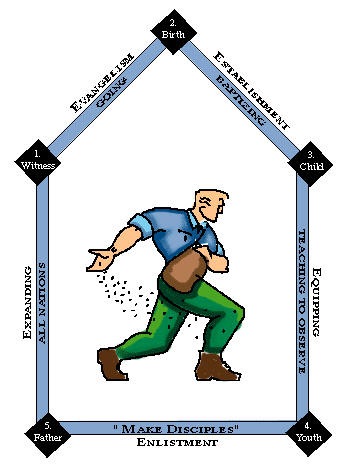
Sections 1 and 2 Using Matthew 28:18-20 and 1 John 2:12-14 as our outlines, the School will cover three degrees of maturity or discipleship—that of the child, the youth, and the father. Recognizing the command of Scripture to be discipled and to disciple others, this course will follow the adjacent overview chart and focus on...
Why Study Old and New Testament Characters?
An overview of why we should study Bible characters.
In this session, I want to offer an overview of why we should study Bible characters.Some have asked, and I'm sure many have thought, "What does the life of someone who lived so long ago have to do with me today?" The cynic might even say, "The Old Testament has little to do with my life—who cares?"
This fall as Hillcrest's staff gathered for our annual retreat, we discussed this question, looking together at 1 Corinthians 10, which really begins in chapter 9, verses 24-27.
Do you not know that in a race all the runners run, but only one gets the prize? Run in such a way as to get the prize. 25 Everyone who competes in the games goes into strict training. They do it to get a crown that will not last; but we do it to get a crown that will last forever. 26 Therefore I do not run like a man running aimlessly; I do not fight like a man beating the air. 27 No, I beat my body and make it my slave so that after I have preached to others, I myself will not be disqualified for the prize.
The context here is on the race, and the potential of being disqualified from receiving the prize.
Ray Stedman has said this passage: "...is built around the figure of an athletic contest—a race. This was a familiar thing to these believers in Corinth. Every three years the Isthmian Games (very much like the Olympic Games we are familiar with, which were also held in Greece), were held right outside the city. If you go to Corinth, you can still see the arenas where the races were run. The starting blocks where the athletes started out the races are still embedded in the stones. Paul is using this figure, because to him, life is a race like that.
These Corinthians knew that every athlete who participated in the races had to take an oath that they had been training for 10 months, and that they had given up certain delightful foods in their diet to enable them to endure the race. They had subjected themselves to rather rigorous discipline in order to win. Paul says all that they are winning is just a fading pine wreath, but, in the race we are running, the prize, the wreath, is an imperishable one.
He sees life this way. Its aim, as Paul understood it, is that we are here to run the race of life in order to be a useful and a pleasing instrument of God, to be used whenever and wherever he wants to use us. That is Paul's objective."
Ray Stedman, Discovery Publishing, 3505 Middlefield Road, Palo Alto, CA. 94306-3695.
Why study characters in the Old and New Testaments?
We all need models. Therefore we study the Bible: to give us examples of those who were disqualified from receiving the prize, and to see those who finished well. Example: The power of a model(for my generation, "The catch" by Willie Mays; today, the home run swings of Sosa and McGwire beating Roger Maris' record). In fact, it can be helpful even to look for biblical characters with your spiritual giftings, and use their models in particular. When it comes to the spiritual race, we need models for several reasons, all of them found in this text.
One Whose Attitudes Lead and Mimic a Child’s
A person God uses is one whose attitudes lead and mimic a child's.
The Mom With Persistent Faith
A person God uses is like the mom with persistent faith.
The Road to Greatness
A person God uses knows the true road to greatness in God's kingdom.
A Cracked Pot
A person God uses is a cracked pot, whose experiences create healing and blessing to be passed out to others.
A Basket Case
A person God uses becomes a basket case and in that experience, discovers Jesus is in the basket with him/her.